Does Handwriting Really Matter?
Content
Yes, it does!
For many years, the importance of teaching handwriting (both printing and cursive) has been downplayed. Printing and cursive writing were removed from most North American curricula because people believed other priorities mattered more, such as exposing students to rich, meaningful text and developing interesting ideas for writing.
Content Columns

As an educator, I didn’t think much about this absence in our curriculum until my own children became young adults. I vividly remember our daughter getting her first bus pass, which she was required to sign. Never having been taught cursive, she didn’t know what to do. We spent several evenings teaching her how to write her name in cursive. I doubt she will ever have a consistent signature she can use to identify herself. This lack of a signature was an interesting side effect of the de-emphasis on handwriting and cursive in our schools.
Now that our educational practices have shifted, we are seeing printing and cursive writing being added back into curricula. It turns out, it is a valuable skill! I find this fascinating, because I never mastered cursive myself. I’m sure I’m not alone in this, and handwriting (particularly cursive) may become one of the many skills teachers need to learn themselves before endeavouring to teach their students.
Content Columns
So, why does it matter?
Why does it matter, you may ask? Kids spend increasing amounts of time on technology. Surely typing and texting is more efficient, making proper letter formation an archaic skill.
As it turns out, this is not the case. Letter formation matters for several key reasons. To start with, students have an easier time recognizing letters when they are taught proper letter formation. Students must pay attention to a letter’s shape to form it, and that focused attention can improve letter recognition. When you think about it, this makes sense. While the research on multisensory letter learning (e.g., writing in sand, sky writing, etc.) isn’t conclusive, any teacher can tell you that these activities increase student engagement. Increased engagement increases attention. Increased attention increases learning… and Bob’s your uncle!
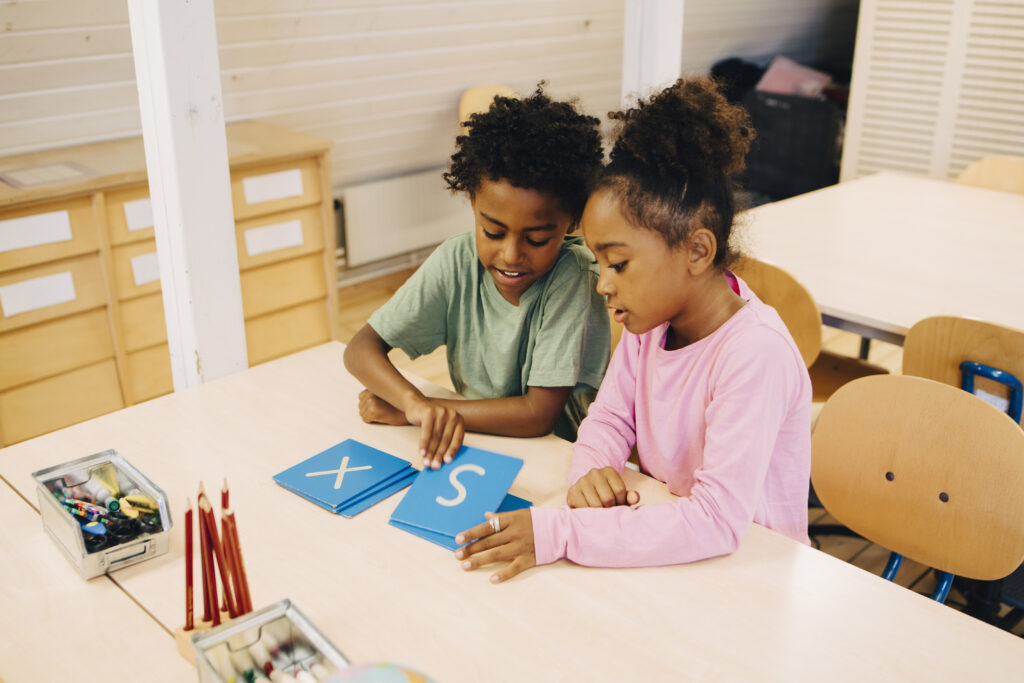
Proper letter formation also reduces letter reversals and letter confusions. An interesting fact: before learning the alphabet, an object’s position in space is typically irrelevant. A spoon is a spoon, whether it is lying on a table, hanging from a rack, or standing in a jar. A <d>, however, is a <p> when upside down. A <w> can look very much like an <m> when flipped (depending on the font). If the formation of the grapheme <b> consistently starts with a downward stroke from the top, it is more clearly differentiated from a <d>, which starts at the circular part, curves around, then goes up to the top line. Engaging a motor pathway seems to help the brain recognize visual differences between letters because it causes students to look at letters through a “pathway” lens rather than as “sticks and balls.”
Finally, teaching proper letter formation reduces cognitive load. If working memory is needed to help students think about how to form letters, it reduces the cognitive energy available to think about what to write and how to spell words. Automaticity develops faster when letter formation is consistent.
Content Columns
Some additional benefits of handwriting that you maybe haven’t considered
As mentioned earlier, many believe proper handwriting isn’t important today because of the widespread use of technology. Typing is indeed faster than handwriting when taking notes in a meeting or class; however, people tend to “transcribe” exactly what is being said without thinking about the words. It’s like the words are just flowing from the presenter’s mouth to the keyboard without any conscious thought. When I was in university, I spent a few years working as an assistant production manager for my university’s newspaper. Long before “Google Docs”, journalists would submit their typed, printed-out articles, and it was my job to type them, word for word, into the newspaper’s computer. I got quite good at this, and it wasn’t unusual for me to reach the end of an article and have no idea what it was about. I was simply transposing from one medium to another without conscious thought.
Writing notes by hand can actually be more beneficial for retention. When you write notes, you cannot write word for word what someone is saying – you just can’t do it fast enough. There is some level of “consolidation” that must happen, and that requires you to actually be thinking about what is being said.

Content Columns
Tips and tricks to get you started
So if you, like myself, are feeling a bit uncertain about delving into handwriting instruction, here are some tips and tricks to help you on your way.
Content Columns
Letter Pathways
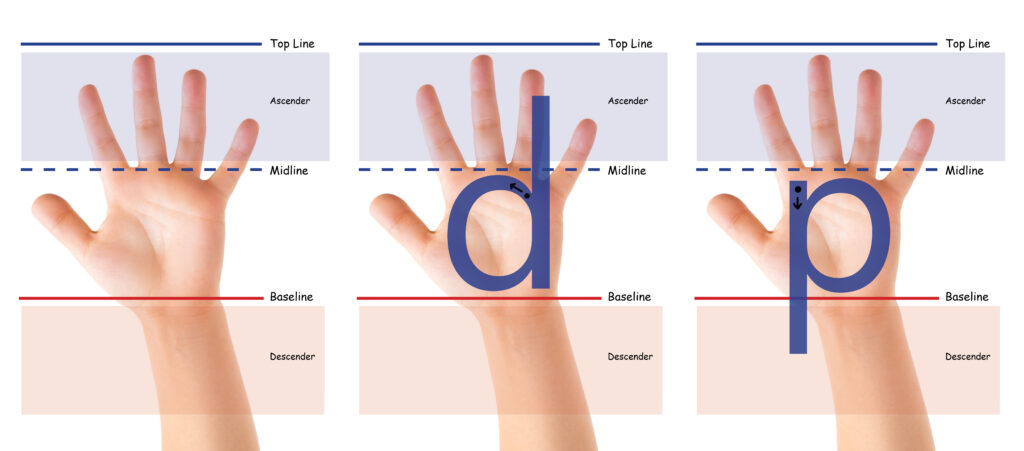
Teach letter formation as a “pathway” with an entrance and exit point, not as a picture (e.g., lines and circles drawn without a continuous pathway). Students can actually use their hands as a guide for letter formation. The palm of the hand becomes the space between the baseline and the midline. The fingers become the ascenders, and the arm the descenders. Students can form the letters on their hand as a practice before writing.
Content Columns
Verbal Pairing
- When learning a new grapheme, have students form the letter(s) while saying the letter name. It helps if they say the letter name as they write it (e.g., say “c” when forming a <c>, rather than /k/). This helps them link the letter name itself with the formation.
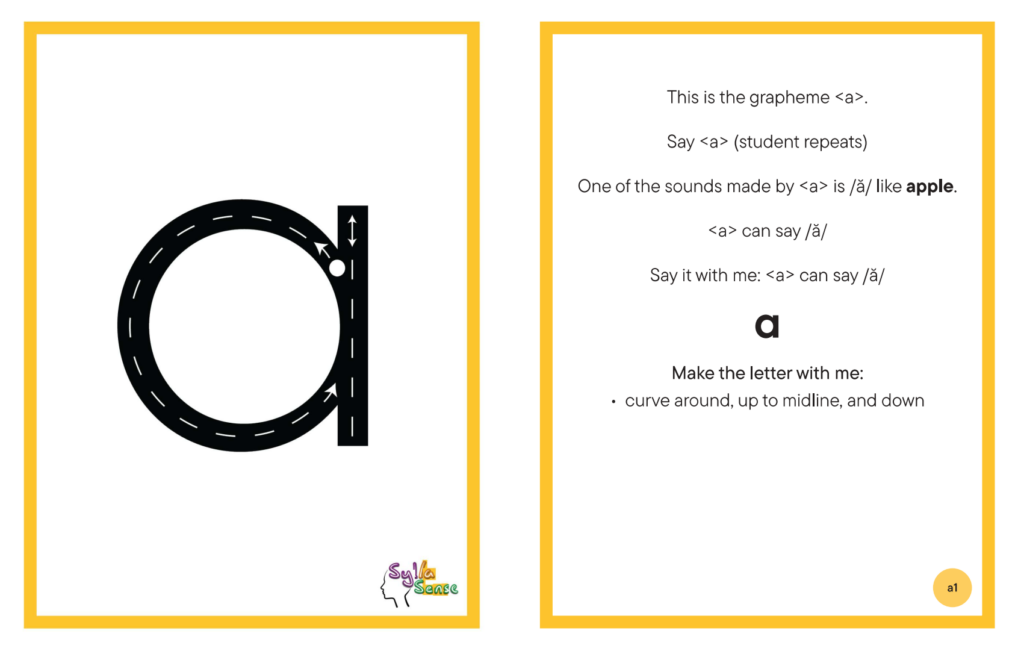
- Add a verbal script to help students remember the pathway. For example, the letter <a>’s verbal script could be, “curve around, up to midline, and down”. If you are looking for a script to try, we have one included on our “Concept Deck”, which can be found on our Teacher Resources page.
Content
Note: Students can form the letter(s) even if their fine motor skills are not yet developed enough to hold a writing utensil. Consider drawing in sand, or in the air with a finger, an arm, a paintbrush, etc. This lets students focus on the pathway rather than on holding the pencil. As mentioned earlier, this can also help students focus on the letter’s shape and learn it faster.
A more advanced idea is to have students practice writing digraphs, trigraphs, and affixes when you teach them. Building motor memory for writing the letters as a unit can be helpful. For example, when teaching <ay>, say “ay” together and have your students write <ay>.
Content Columns

Yes, Handwriting Really Matters!
This blog is coming to you from someone with poor handwriting (not the best quality for a literacy teacher, you may think). I have, however, found handwriting instruction to be very beneficial for my students. Partway through my tenure as a kindergarten teacher, I began to teach letter formation as part of my morning routine. I had students practice the “pathway” of each letter while saying the letter name aloud. This daily practice seemed hugely effective for students struggling to learn letter-sound correlation. Maybe the pathway helped, or maybe it just drew their attention better. Whatever the cause, my students benefited from this practice.
Hopefully this post has given you some things to think about and some tips for getting started with handwriting instruction with your students. If you are interested in learning more about what is happening in our brain when we write, check out the article below. I found it a fascinating read.
Next time, we’ll delve into the power of doing word-level, phrase-level, and sentence-level work with your students.
we
will have some fun
with phrases
🙂